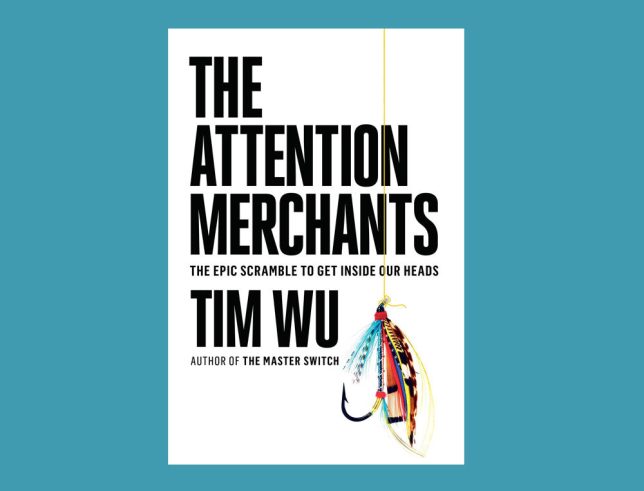
Tim Wu’s The Attention Merchants: The Epic Scramble to Get Inside Our Heads is a history of the attention economy: the business model through which newspapers, advertisers, broadcasters, technology companies and social-media platforms have learned to capture human attention and resell it for profit. My colleague, John Bell and I have just reviewed the book for the Los Angeles Review of Books, examining what Wu’s history tells us about advertising, Big Tech, privacy and the commercialization of consciousness.
To give and receive attention is a fundamental human need. Some have pointed out that attention exchange is often the main, underlying motive for any human interaction, regardless of the actors’ overt intention.
In The Attention Merchants, Tim Wu argues that modern media industries are built around capturing human attention and reselling it to advertisers. Wu shows us how technologists, profiteers and politicians take advantage of this deep human preponderance for their own advantage. So efficient has this process become, and so complete the conquest, that we can say that our awareness is now being commercially farmed.
 Bell and I write: “According to Wu, the attention merchant’s basic modus operandi is to engage us with ‘apparently free stuff’ and then resell our attention to others. In this regard, smartphones and tablets — and the applications that support them — represent a quantum leap in the industry’s efforts to win and hold our attention. They are the frontline harvesting machines. So efficient has this process become, and so complete the conquest, that we can say that our awareness is now being commercially farmed. Furthermore, there is no harvest “season” for this industry. It is happening all the time and around the clock: in our homes, on the street, in our workplaces, during vacations. It is a symphony of mental entrancement on a global scale.”
Rather than merely chronicling the history of advertising, media and big tech, Wu’s narrative invites us to consider how this economy of attention affects privacy, democracy, and personal agency in the digital age—themes that I later explored in greater depth in my book Veils of Distortion: How the News Media Warps Our Minds.
In our review, we explored how this relentless monetization of attention reshapes not just market behaviour but the very experience of consciousness, arguing that smartphones, tablets, and algorithm-driven platforms have become the frontline harvesting machines in this global trade of awareness.
Read our full article, entitled “The Great Attention Heist” on the Los Angeles Review of Books.