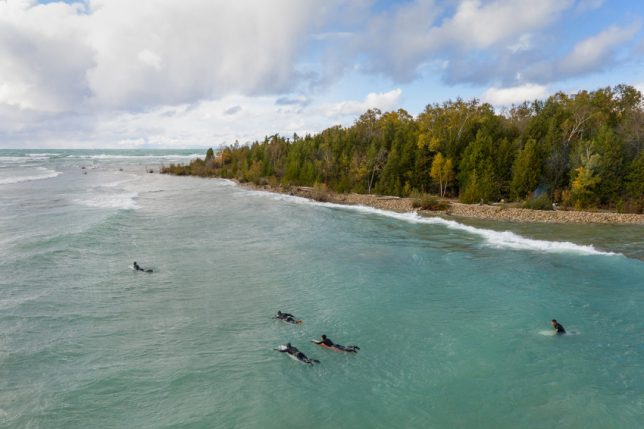
As a travel writer and lifelong consumer of travel literature, I’ve always been most drawn to books about remote locales and settings. My longstanding assumption has been: the more foreign and alien the destination in a book, the more novel and entertaining the tale. Which is why, when I recently picked up The Living Great Lakes: Searching for the Heart of the Inland Seas by Jerry Dennis—a sort of travelogue-cum-natural history of North America’s fresh water seas on whose shores I live in Toronto—I was more than pleasantly surprised. His work is an exception to the idea that great travel writing can only plumb the distant and exotic.
In the book, Dennis, an American who lives in Michigan, joins the crew of a tall-masted schooner, which is sailing from his home state through the Great Lakes to be delivered to its new owner on the US East Coast. The journey serves as his core narrative on the subject of the Great Lakes, segueing into past experiences and stories of previous trips related to the conjoined sweet-water seas that are Lakes Superior, Michigan, Huron, Erie, and Ontario. Those combined waters, Dennis tells us, hold 25% of all fresh water on the Earth.
 The award-winning book, which came out in 2003, is brilliantly written, and chock full of eyebrow raising stories, characters and historical information—including the shocking extent to which the Great Lakes were once, and still remain, seriously polluted. This is a hugely sobering and dismaying piece of underreported news, given the tens of millions of people in both Canada and the US who rely upon and take these waters for granted.
Two writerly thoughts, more personal, came to mind while reading this book. The first is that there is greater potential than one realizes for producing travel writing about one’s own neighbourhood or region—as opposed to chasing exponential novelty at the far-flung edges of the Earth. Travel writing does not have to mean dropping into a place one has never visited and knows nothing about. I definitely had a Now why didn’t I think of that? moment when reading the book. I should have realized that this was a topic worthy of serious travel writing when my now wife moved to Toronto from Vancouver, and seeing Lakes Ontario and Huron, quipped that she’d never known lakes that had the appearance and behaviour of seas. In fact, Dennis writes at the start of his first chapter: “The first time I saw Lake Michigan, I thought it must be an ocean.”
The other thought, related of course, is just how little I know about my own corner of North America. Although the book covered some areas I’ve visited and am familiar with, there were other places, a few nearby, that I hadn’t even heard of. Some of them are blind spots on literal maps I’ve always looked at and was stunned to learn about: the wild and uninhabited (and never-once-before-mentioned-by-anyone) Isle Royal in Lake Superior; Long Point on the Ontario side of Lake Erie with its biosphere reserve, provincial park, and cluster of shipwrecks known as the “Lake Erie Quadrangle” (think ‘Bermuda Triangle’); the Straits of Mackinac connecting Lakes Huron and Michigan, famous locally for its fast-moving currents, hazardous shoals, cyclonic winds, (ie, more shipwrecks) and a traffic bridge that will sway and possibly throw you—and your car—into the lake during gales.
Or take this tantalizing and likely still valid description of Lake Superior’s mostly Canadian north shore:
Though most of the land surrounding the Great Lakes has been altered beyond recognition, Superior’s north shore has changed little. For mile after mile there are no human signatures of any kind. Contained within Lake Superior Provincial Park, Pukaskwa National Park, the bulky protrusion of the Pukaskwa Peninsula, and the Nipigon country are roadless forests and the least visited and most rugged shoreline in the Great Lakes. Moose, black bear, and wolf live there, and remnant populations of woodland caribou. It is still la marge sauvage “the wild shore.” You can see glimpses of time’s broad scale there. A paddler in 1800 saw the same remote shore lined with the same billion-year-old rocks. He saw the same crystalline waves breaking on the same cobbled beaches, saw the same spruce forest rising away to an interior wilderness so vast it seemed infinite.
And of course, there are the legendary and nasty ocean-like storms that churn huge lethal waves, which most of us landlubbing residents of the lakes never experience (or even hear about) except when a ship such as the 700-foot long SS Edmund Fitzgerald goes down—as happened in 1975. Cue the melancholic namesake Gordon Lightfoot song.
There’s so much more in these pages. I frankly feel a bit silly for not knowing more of it earlier, given how long I’ve lived beside, frequently visited, and so often flown over, this veritable combined ocean which surrounds us in southern Ontario.
