

I boarded an Air Canada flight home from Vancouver to Toronto last year. I was upbeat about that daytime trip as the trajectory of that route takes you over a fascinating cross-section of Canada’s geography: from the burley and conifer-carpeted Coast Mountains, to the sharp pinnacled Rockies, and out across a wide expanse of the Prairie with its multi-toned checkerboard fields, hummocky moraines and kettle ponds, to the Great Lakes.
I had deliberately reserved a window-seat, and was relishing getting some glimpses, especially on the B.C. stretch, of wild places I’d explored over my many visits there.
But then something odd and disturbing happened.
Once we reached cruising altitude the crew automatically dimmed all of the windows on the plane, throwing the cabin into semi-darkness—although it was a daytime flight. The aircraft was equipped with what are called “electronically dimmable windows” (EDW), featured on some newer planes, which allows passengers to manually darken the windows in increments with the push of a button rather than pull a manual blind down. On this flight the crew unilaterally darkened them for all. Our four-hour scamper across a continent’s vicissitude of landscape was rendered into an overnight long-haul style flight cast in the tungsten-lit gloom of semi-darkness.
Few people, as far I could tell, seemed to care. Most passengers had long entered their personal screen trances. The airplane cabin glowed and flickered with the silent cacophony of its rows of digital channels.
Yet I was hellbent on keeping my access to daylight and view of the outside world. I pressed the button to remove the digital shade. Slowly, a beam of daylight poured across the row of empty seats beside me. The transgression, which must have been considerable, drew a flight attendant to my side.
“Sir, you’re going to have to dim your window for the flight.”
“But it’s the middle of the day,” I complained.
“Sir, you’re disturbing the other passengers.”
I nearly accused him of wanting to put us all to sleep so that he and his colleagues could spend the flight gabbing uninterrupted at the back of the plane. Indeed the airline staff seemed more than usually absent from the cabin on that particular trip.
I’ve flown a few times since and have noticed (as have others, including one airline employee I spoke with) that the daytime blackening of the airplane cabin on some flights is becoming de rigueur—and with overwhelming passenger conformity. Even on planes with the manual pull-down shades, the new unofficial edict has caught on and become self-enforced. Nowadays many passengers at the window seat choose to shut themselves—and the rest of us—out of daylight radiance and its benefits: from possible eye-contact and discussions with others, to naturally-lit reading and thinking, to simply watching life in the airplane cabin unfold.
I admit this partly relates to my own subjective preferences while flying. Yet the poignancy of collectively blackening the windows in daytime and turning our backs on the outside world and all that is real—including the possibility of magnificent big picture aerial views—is jarring. Given that passengers darken the cabin largely to better view their screens, the act symbolizes, par excellence, our modern digital-facilitated descent into small-mindedness and oblivion. It also signals a troubling loss of appreciation of not just a magical aspect of living (soaring high above the Earth), but of the most basic human dignity: exposure to the illuminating light of day.
The question surrounding one’s preference for, or against, the airplane window seat is a schismatic one. Some people deeply crave the corner nook, window view, and sideways place to rest one’s head. Partisans of the aisle seat, possibly for reasons of independence and control, recoil from the window’s cornering claustrophobia and opt instead for convenient restroom trips, occasional stretches, or even a beeline to the emergency exit in an unlikely crash.
I tend to sign-up for the window on daytime flights mostly for the rare opportunity and pleasure of gazing upon the world from aloft. This fascination began in childhood during flights to the United States while on vacation with my parents. Those earliest trips were veritable magic carpet rides, when the window view was one of the most astonishing things ever to have happened to me, and heavy air turbulence was an amusement park-style ride. As a pre-teen I turned this ground-gazing obsession into an educational pursuit by carrying with me on every flight one of those gargantuan Rand McNally road atlases of North America designed to sprawl atop tables inside recreational vehicles. Long before planes had personalized screens or showed detailed flight paths, I used the atlas to track and follow the trajectory of our flights, identifying cities, towns, rural roads, national forests, lakes, rivers, and even mountains. Those of us inclined to broaden our knowledge in just such a way were aided and abetted by our allies-in-navigation: the airline pilots. Unlike today, those enthusiastic sky captains of yore came on the intercom to inform us that on either the left, or right side of the plane, we could see the Hoover Dam, or Mount Rushmore, or Augusta, Georgia—places I would otherwise never gaze upon from any direction.
During one flight to San Francisco, when I was fourteen, we flew over Nevada, passing far to the north of Las Vegas, along the edges of what my atlas told me was the restricted airspace of the Nellis Air Force Range—a highly secretive U.S. aircraft and weapons test site. Though the idea of it was thrilling to my Cold War cognizant teenage mind, the window view of the largely empty landscape, the water-streaked dry gullies and clusters of desiccated brown mountains, threw a wet blanket onto my mental rendering of the World War 3 practice-range. In the far distance, though, I could barely discern a straight-line, the thread of a lonely road passing between mountains, and maybe a few buildings. Much later, in retrospect I realized I had likely glimpsed upon the iconic ‘Area 51’, a decade prior to its sensational pop-culture unveiling as the purported Ufology hub of the American military.

Kettle ponds in the Canadian prairies near Saskatoon, Saskatchewan. Photo © John Zada

Unknown island volcano, off the Alaskan Peninsula, North Pacific. Photo © John Zada.
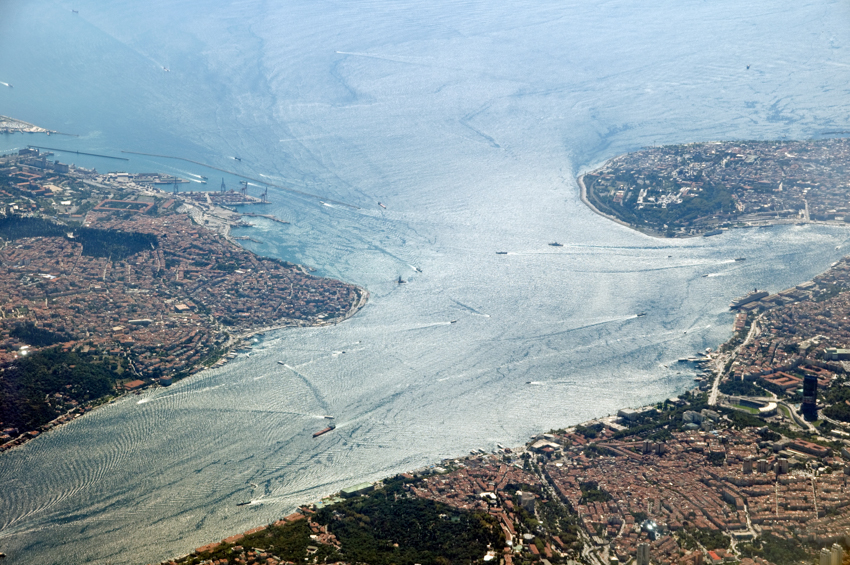
Ship traffic on the southern end of the Strait of Bosphorus, Istanbul, Turkey. Photo © John Zada.
Since then, as an adult, I’ve made the window seat on day flights a recurring habit, a kind of good mental and spiritual hygiene practice. More often than not I have been rewarded by the weather gods with clear views of all of manner of landmarks. It’s not just the new reveals, many of them Edward Burtynsky-esque, that catapult me out of my daily ordinary and spark wonder, such as seeing the city of Airdrie, Alberta, appearing on the empty plains around it like a square microchip; or a cluster of brooding snow-capped Aleutian Island volcanoes taking me back to a primeval lost age of the Earth; or a cluster of container ships and tankers bunching outside the entrance to the Strait of Bosphorus in the Sea of Marmara in Turkey.
But it’s the familiar that I most savour seeing, if only for the tonic-like jolt of gazing upon something already known, but from a totally new perspective: from a remote mountaintop I’ve hiked to in the Coast Ranges of British Columbia, to the familiar streets and buildings of my home city of Toronto.
One of the bigger takeaways of all of this window-gazing has been the realization that regardless of the fear or anxiety we may harbour about our crisis-ridden world, from high above the Earth we can see the wider planet before our eyes in all its great sprawling majesty and calm disposition. There is something therapeutic too, a blow to the ego perhaps, in knowing that each of us is that lonely driver on a rural road five miles down, that tiny dot moving at a nearly indiscernible crawl.
But most of all the airplane view is also a much-needed reminder that there is such a thing as a bigger picture, a wider lens, a different take on what we think we know, seen from another vantage point. Perception is malleable and subject to change, with the picture presented appearing slightly different depending on where one is looking from.
Peering out from that window can be much the same eye- and mind-opening process that astronauts experience when looking down on the Earth, giving rise to big thoughts and sentiments that unite into a larger whole, hinting at the interconnectivity of all things. It’s what the pitch-black sky of night used to trigger before light pollution negated that large-canvas wonder that is now shut out to most of us – like an airplane window rendered dark with a pull of the flap.
Like nearly everyone, I enjoy losing myself in films when flying—especially on long-haul trips. I’ve even pulled the window shade down and slept while travelling. There’s nothing wrong with that. It’s less the individual cases and more the collective shift in culture that has astonished me; one which is increasingly spurning analog reality.
It may strike as hyperbole, but our compliant and voluntary darkening of airplanes during the day to enter our digital rabbit-holes is an almost perfect metaphor for a new and subtle dark age that has come over us. The wonder of flight, the value of a rare perspective, the excitement of seeing the real world from a vantage point known only to shamans and lucid dreamers before the invention of planes, has given way to a sleep-induced mechanical indifference.
What happened?
Part of it is adaptation to the routines of air travel. The experience of flying is so ubiquitous today, its grinding rituals so banal and blasé, that air travel is considered a deeply inconvenient necessity at best, and a hardship to endure at worst. We Band-Aid over it with the great poultice and narcotic of our age: digital distraction. In a Faustian bargain we’re barely conscious we’ve made, even the stranger sitting beside us—a “window” unto another world of anecdote and experience—is spurned for the screen-based shadow-play of our personalized Plato’s caves.
It needn’t apply strictly to flying: we all see scores of people every day pull their “window shade” down to look at their screens as they walk down the street, nearly running into everyone in the process—something similarly, if not more, inconceivable. Going anywhere now is all destination, and no journey.
Our aversion to what is real and wonderful, like an airplane view of a rare and mysterious planet we only briefly inhabit, should be a stark warning about an important part of ourselves that is quickly becoming lost.
*
A version of this article appeared in the online edition of the Globe and Mail on December 21, 2024 entitled “New planes that can limit window-gazing are taking the magic out of flying.”


